How to find and fill off-peak hours at a padel club
PadelEco Team
Padel club operations
3 min read
On this page
How do you calculate occupancy correctly?
Occupancy is the share of available court time that is actually used:
Occupancy = booked court-hours ÷ available court-hours × 100
Available court-hours are courts × opening hours × days. A club with 4 courts open 17 hours a day has 476 available court-hours a week. If 250 of them are used, weekly occupancy is 52.5%.
Two details change the answer more than people expect:
- Count everything that uses a court. Public bookings, classes, private lessons, academy sessions, and internal reservations all take a court away from open booking.
- Do not count the same hour twice. If a class is also blocked in your booking app, it is still one court-hour.
Why is one occupancy average misleading?
A monthly average blends your best and worst hours into one number. Two clubs at 55% can be in completely different situations: one is busy all day, the other is sold out every evening and empty until 17:00.
Break occupancy down into a grid of weekdays and hours. The pattern usually jumps out: evenings and weekend mornings run hot, while weekday late mornings and early afternoons are pale.
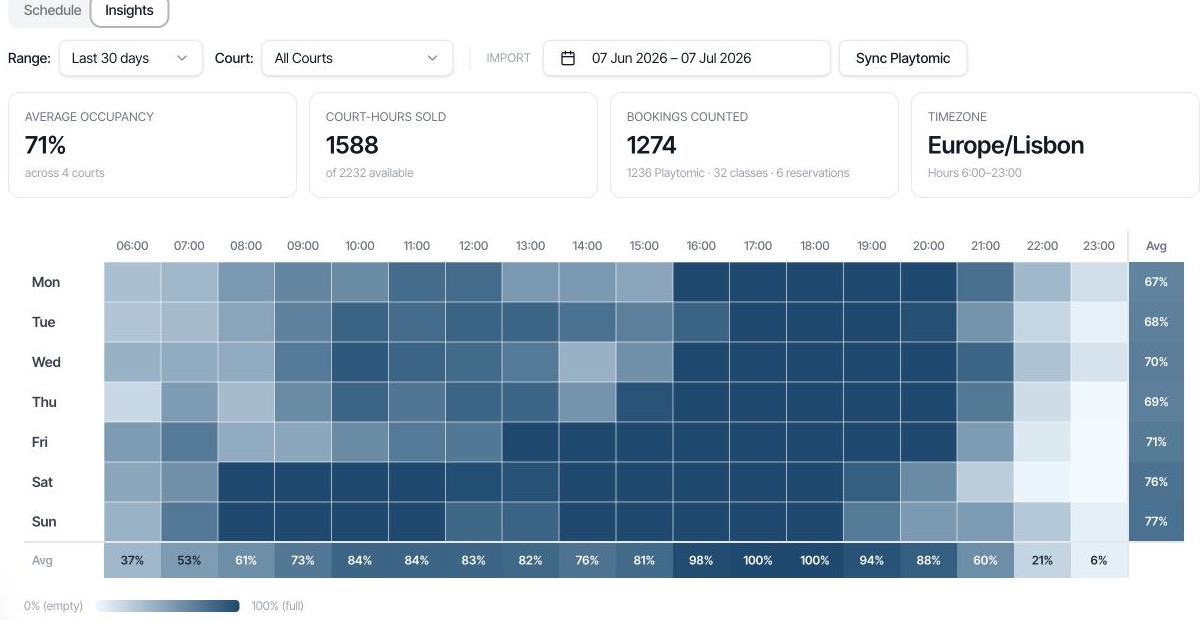
Look at the averages along the edges as well as the cells. A weak column is an hour that is slow every day. A weak row is a day that is slow at every hour. They need different fixes.
Which formats fill weekday daytime hours?
Start from who is actually free when your courts are empty, then design a reason for them to come.
| Quiet slot | Who is free | Formats that fit |
|---|---|---|
| Weekday mornings | Shift workers, retirees, parents after school drop-off | Beginner and social classes, seniors' groups |
| Weekday early afternoon | Remote workers, students, companies | Lunch-hour matches, corporate groups, university sessions |
| Weekday late afternoon | Juniors after school | Academies and junior programmes |
| Late evening shoulder | Regular players who missed peak | Leagues and fixed-night americanos |
The Global Padel Report 2026 names these structured formats, open matches, courses, academies, and in-house competitions, as decisive for improving revenue and keeping demand steady (Actu Padel summary). They work because they book the same slot every week instead of hoping for open bookings.
Should you discount off-peak court time?
Slot-based pricing makes sense: an evening court and a Tuesday 11:00 court are different products. But a blanket discount has two risks. It can teach flexible players to wait for cheaper hours, and it lowers revenue on hours that might have sold anyway.
A more controlled approach:
- Protect peak prices and change only the slots your grid shows as consistently weak.
- Bundle instead of discounting. Include off-peak hours in a membership or class package rather than cutting the public price.
- Change one thing at a time so you can tell what worked.
How do you know it is working?
Compare the same slot over several weeks, not this week against last week. Weather, holidays, and school calendars swing a single week.
Track three numbers for every slot you change:
- occupancy in that slot, week by week
- occupancy in the neighbouring peak slots, to make sure you are not just moving players
- revenue per booked court-hour, to make sure fuller does not mean cheaper overall
If a slot fills and peak holds, keep the change and move on to the next pale cell.
Frequently asked questions
What is a good occupancy rate for a padel club?
There is no single benchmark that fits every club, because opening hours, prices, and markets differ. Evenings and weekends are usually far fuller than weekday daytime, so judge occupancy by slot and by trend over several weeks rather than by one monthly figure.
Should classes count toward court occupancy?
Yes. A court used for a class is not available for open booking, so it counts as used. Track classes separately as well, so you can see how much of your occupancy comes from programmes versus open bookings.
How often should a club review occupancy?
Weekly by slot for spotting problems, and over four to eight weeks before judging a pricing or schedule change. Single weeks are too noisy because of weather, holidays, and school calendars.